A motorcycle helmet serves two important goals: first, it protects your head in a crash. Second, but equally importantly, it protects your head and keeps you comfortable while riding.
How does it work
The helmet has a hard outer layer - polycarbonate, fibre glass or composites - meant to absorb and spread impacts. It resists penetration by sharp objects and the shell disperses the forces of the impact.
Between your skin and this shell is an energy absorbing layer, usually polystyrene, that is designed to gather this energy and self-destruct, transferring as little force as possible to the head.
The polystyrene is covered with a comfort-oriented layer of fabric, which is sometimes removable for washing. Add a good, scratch resistant visor and a secure retention system, and you have a helmet.
Types of Helmets
There are four basic types of helmets: full-face, 3/4 helmets, half helmets, and flip-face (or modular) helmets.
 |
Full-face helmets
Full-face helmets wrap fully around your head, and offer the best protection both while riding, and in a crash. All full-face helmets that I'm aware of have a flip-up visor, which is typically removeable without tools. This is the type of helmet I own. This is the only type of helmet I recommend. |
 |
Flip-face (modular) helmets
Flip-up (or modular) helmets are a compromise between the protection of a full-face helmet, and the convenience of a 3/4 helmet. Being a compromise, they are neither as protective as a full-face, nor as convenient as a 3/4. However, if you can't stand the thought of a full-face helmet because of glasses, or being able to talk to people with your helmet on, a flip-up may be a good choice for you. I am personally undecided on them, but stick with a full-face because I don't feel hampered by the design. A good flip-face helmet is a far better choice than a 3/4, so always pick the modular if you feel a full-face isn't an acceptable choice. |
 |
3/4 helmets
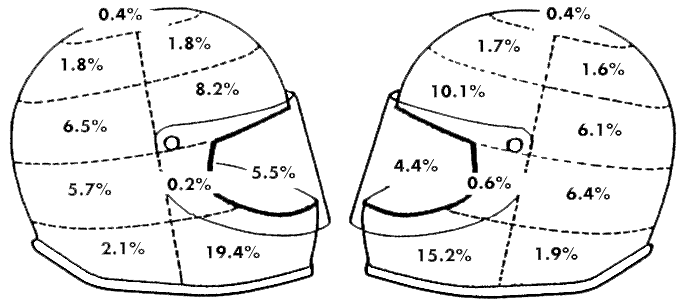
The three-quarter helmet seems to have been very popular in the 1970s, when there was a huge surge in motorcycle ownership in the US. I've read that full face helmets of that time were bulky and heavy, making a 3/4 helmet a much more comfortable choice. This is no longer the case, and 3/4 helmets are not a wise choice. They leave your chin and face exposed, both to oncoming objects like rocks and bugs, and to the pavement in a crash. Take a look at this diagram, which shows where crashed helmets took hits. Note how the areas with the largest percentages are on the chinbar. Note how a 3/4 helmet has no chinbar. |
 |
Half helmets
Half helmets, also called "brain buckets" and "puddin' cups" offer very little protection either in a crash or while riding. The market for these helmets seems to be cruiser riders who want to project a tough or scofflaw image. They have the greatest feeling of freedom of all types of DOT-approved helmets. If you value your life at all, avoid half helmets. |