
How does it work
The helmet has a hard outer layer - polycarbonate, fibre glass or composites - meant to absorb and spread impacts. It resists penetration by sharp objects and the shell disperses the forces of the impact.Between your skin and this shell is an energy absorbing layer, usually polystyrene, that is designed to gather this energy and self-destruct, transferring as little force as possible to the head.
The polystyrene is covered with a comfort-oriented layer of fabric, which is sometimes removable for washing. Add a good, scratch resistant visor and a secure retention system, and you have a helmet.
Types of Helmets
There are four basic types of helmets: full-face, 3/4 helmets, half helmets, and flip-face (or modular) helmets. |
Full-face helmetsFull-face helmets wrap fully around your head, and offer the best protection both while riding, and in a crash. All full-face helmets that I'm aware of have a flip-up visor, which is typically removeable without tools. This is the type of helmet I own. This is the only type of helmet I recommend. |
 |
Flip-face (modular) helmetsFlip-up (or modular) helmets are a compromise between the protection of a full-face helmet, and the convenience of a 3/4 helmet. Being a compromise, they are neither as protective as a full-face, nor as convenient as a 3/4. However, if you can't stand the thought of a full-face helmet because of glasses, or being able to talk to people with your helmet on, a flip-up may be a good choice for you. I am personally undecided on them, but stick with a full-face because I don't feel hampered by the design. A good flip-face helmet is a far better choice than a 3/4, so always pick the modular if you feel a full-face isn't an acceptable choice. |
 |
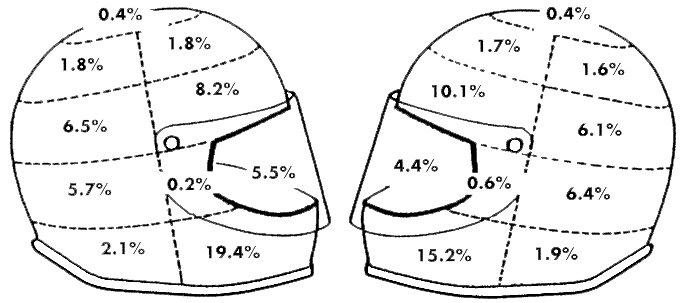
3/4 helmetsThe three-quarter helmet seems to have been very popular in the 1970s, when there was a huge surge in motorcycle ownership in the US. I've read that full face helmets of that time were bulky and heavy, making a 3/4 helmet a much more comfortable choice. This is no longer the case, and 3/4 helmets are not a wise choice. They leave your chin and face exposed, both to oncoming objects like rocks and bugs, and to the pavement in a crash. Take a look at this diagram, which shows where crashed helmets took hits. Note how the areas with the largest percentages are on the chinbar. Note how a 3/4 helmet has no chinbar. |
 |
Half helmetsHalf helmets, also called "brain buckets" and "puddin' cups" offer very little protection either in a crash or while riding. The market for these helmets seems to be cruiser riders who want to project a tough or scofflaw image. They have the greatest feeling of freedom of all types of DOT-approved helmets. If you value your life at all, avoid half helmets. |
Choosing a Helmet
"You should never buy a used helmet, period. Helmets are perishable, and one that's 2 years old offers measurably less protection than a new one. The materials that make up the helmet degrade over time, and particularly with use. If you're going to spend money on a helmet, it should be for a brand new one, as fresh from the manufacturer as possible. Yes, this also means you should plan on buying a new helmet every 3-4 years."- After selecting the type of helmet of your preference (full face helmets would be our preference), you really need to try wearing them out.
- Holding the helmet by the straps, you should pull it down over your head. If the fit is right, you should feel a gentle, but firm pressure from the helmet evenly all over the head.
- The cheek pads pushing your cheeks up slightly is normal. Now adjust the straps and fasten the helmet. Wag a vigorous no sign with your head, if the helmet does not move seamlessly with you, it isn't snug enough.
- Wear the helmet for ten minutes or so. If you have never worn a helmet before, some aches in the neck area will go away once you get used to it. Serious ache means you need a lighter helmet.
- When you remove the helmet (not sliding off your head easily is normal; push up rather than roll up and back at the same time), look for redness of skin or signs of pressure points. If the lining is pressing a specific area, it will give you a headache later. You want an even fit.
- The one thing to ensure is that there is minimal contact between your ear and the helmet. On long rides, this will give you a really painful earache.
- Reflective elements to make you more visible at night.
- Among the features, look for effective and lots of venting for Indian conditions. They might look gimmicky, but a properly vented helmet can feel cool even on a really hot day. Some Indian helmets come with fake vents, so be sure that it actually has vents.
Final recommendations
Three-quarter and half helmets are only suitable for morons. Don't spend money on them.Now that you have a helmet, the job isn't all done. Helmets need to be treated like fragile objects. If it's always banging against stuff and keeps being dropped, when you do need it to protect your head, it will fail.
Needless to say, helmets save more motorcyclists from serious head injuries every day. Studies across the world suggest a forty per cent lower chance of serious head and neck injuries due to helmet use in motorcycle accidents.
Its very important to select and wear an helmet correctly.
Some good references can be found here:-
- http://obairlann.net/reaper/motorcycle/beginner/helmets.html
- http://www.rediff.com/money/2006/aug/26spec.htm
- http://www.motorcyclecruiser.com/streetsurvival/0008_crup_how_to_buy_motorcycle_helmet/index.html
- http://www.webbikeworld.com/Reviewed-motorcycle-products/Products.htm


No comments:
Post a Comment